

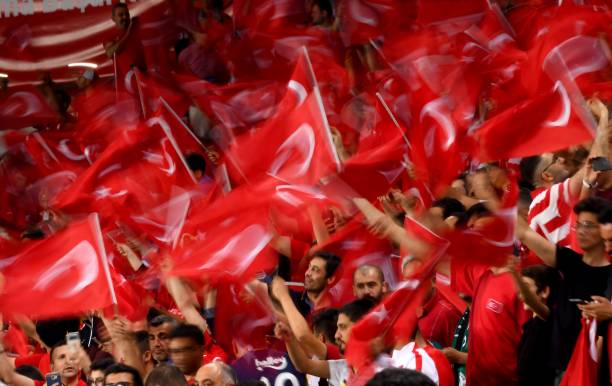
Ending a 24-year hiatus from football’s grandest stage, the Turkish national team enters the 2026 FIFA World Cup as a highly dangerous wildcard, with tactical fluidity and unpredictability flagged as their ultimate competitive advantages.
In an extensive tactical analysis of Group D published by Fanatik, sports analyst Burak Özdemir broke down the dynamics governing the four-team pool, positioning the eventual clash between Turkey and co-hosts United States as the decisive fixture that will dictate the group leader.
Turkey’s Path and Montella’s Tactical Chess board
The Crescent-Stars secured their long-awaited tournament ticket via a grueling qualification campaign. Turkey finished second in UEFA Qualifying Group E, trailing powerhouse Spain by just three points. The squad then navigated the high-stakes playoff route, systematically dismantling Romania in the semi-finals before defeating Kosovo in the final.
Under the stewardship of Italian manager Vincenzo Montella, Turkey has adopted a baseline 4-1-3-2 formation, though the setup remains highly malleable.
-
The Tactical Wildcard: Montella frequently alters his structural choices based entirely on the opposition. A prime example is the deployment of winger Kerem Aktürkoğlu as a “false nine” to disrupt traditional center-backs.
-
The Dual Nature of the Roster: The analysis underscores a distinct contrast within the Turkish lineup. The attacking department boasts elite, world-class individual match-winners capable of unraveling any defense in the tournament. Conversely, the backline struggles with recovery speed and athleticism, making transition defense a critical vulnerability.
Scouting Report: The Group D Competitors
Group D presents a diverse mix of tactical styles, spanning Asian resilience, South American defensive grit, and North American athletic intensity.
The Battle for the Top Spot
While Australia and Paraguay possess the collective discipline to cause upsets, the analytical consensus indicates that the United States and Turkey are the heavy favorites to progress to the knockout rounds.
The United States enters the tournament with distinct advantages, most notably home-field support and a highly potent forward line. Striker Folarin Balogun arrives in elite form following a prolific 19-goal domestic campaign with Monaco, anchoring an attack that possesses vastly superior raw athleticism compared to Paraguay and Australia.
However, much like Turkey, Pochettino’s side has struggled to find defensive stability, consistently conceding goals against top-tier opposition. Consequentially, the direct head-to-head match between Turkey’s unpredictable creative engine and the USA’s high-octane transitional offense is widely expected to be the defining spectacle of the group stage.